
Looking for the best things to do in Montmartre?
This guide covers the top sights, hidden gems, and local spots in Montmartre—so you can easily plan your visit and not miss the highlights.
With its cobbled streets, artists, and sweeping views over Paris, Montmartre is one of the city’s most iconic neighborhoods—but knowing what’s actually worth your time can make all the difference.
I’ve lived in Paris for over 20 years and have explored Montmartre countless times, so I’ve put together a mix of must-see attractions and lesser-known places most visitors overlook.
Whether it’s your first time in Paris or you’re looking to experience Montmartre beyond the usual tourist stops, this guide will help you make the most of your visit.
💡 Montmartre at a Glance
Short on time? Here’s what not to miss in Montmartre:
→ Below, you’ll find 38 detailed ideas to help you plan the perfect visit.
Best Things to Do in Montmartre
It’s hard to think of another area in Paris that feels so distinct as Montmartre. No matter how much or little time you have in Paris, you always should make sure to plan a few hours to explore Montmartre.
Montmartre has almost an overload of charming sites, historical attractions, and cute alleys to stroll through. To make sure you are not missing anything, here is my list of 38 things to do in Montmartre.
#1 Visit the Basilica Sacre Coeur
The Sacré-Cœur is one of Paris’s most visited landmarks, sitting high on Montmartre’s hill with unbeatable city views. It is one of the newer churches in Paris, built only in the late 19th century.
Its bright white facade and iconic domes stand out as a defining feature of the Parisian skyline.
Inside, the basilica is just as impressive. You can wander through its serene interior, marvel at the intricate stained-glass windows, or climb the bell tower for panoramic views that are worth every step.
While the entry to the Basilica is free, the bell tower requires a ticket.


#2 Join a Cheese, Wine & Pastry Tour in Montmartre
→ My pick: 3-Hour Montmartre Cheese, Wine & Pastry Tour
If you want to understand Montmartre beyond photos and viewpoints, taste it.
This small-group walking tour combines three things France does exceptionally well: cheese, wine, and pastries. And instead of randomly picking a café, you’re guided to carefully selected spots with proper explanations along the way.
You’ll stop at artisan shops, learn how to read a cheese counter without feeling intimidated, taste regional wines, and try classic French pastries — all while strolling through Montmartre’s quieter streets.
What I like about this experience is that it blends history with food. You’re not just eating. You’re understanding the neighborhood through its culinary traditions.
It’s also a clever way to “do lunch” without having to research restaurants yourself.
→ If you’d like a structured, delicious introduction to Montmartre, check availability for your dates here.


#3 See a Cabaret Show at the Moulin Rouge
The Moulin Rouge is as much a part of Montmartre as the Sacré-Cœur or its community of artists. With its iconic red windmill, this legendary cabaret has been dazzling audiences since 1889 and remains one of the symbols of Parisian nightlife.
It’s glitter, choreography, feathers, Champagne — but also history. Montmartre’s cabaret culture shaped the spirit of the neighborhood, and while you can learn about it at the Musée de Montmartre, seeing a show yourself is a completely different experience.
It’s polished, theatrical, and unapologetically Parisian.
→ Shows often sell out days in advance, especially on weekends. If this is on your list, check availability for your dates and reserve early.
Choose the Moulin Rouge Experience That Fits You

#4 Visit the Musée de Montmartre
➤ Read more here: Musée de Montmartre: Discover the Heart of Bohemian Paris
This small but fine museum is absolutely unmissable if you are interested in the history of Montmartre and are keen on understanding where that special Montmartre flair is coming from.
The Museum is located on top of the hill, between the Basilica Sacre Coeur and La Maison Rose, and consists of several parts.
The museum itself is about the history of the renowned artist quarter, with many artworks and original pieces on display.
If you can, have a coffee or tea in the beautiful Café Renoir that belongs to the museum.
To the Musée de Montmartre belongs a beautiful, lush garden that is inviting you to stay a bit and from where you havefantastic views over the Montmartre Vineyards.
→ Secure your entry time here — especially on busy weekends


#5 Wander on Rue de l’Abreuvoir
If you’re looking for one of the most photogenic things to do in Montmartre, walk down Rue de l’Abreuvoir.
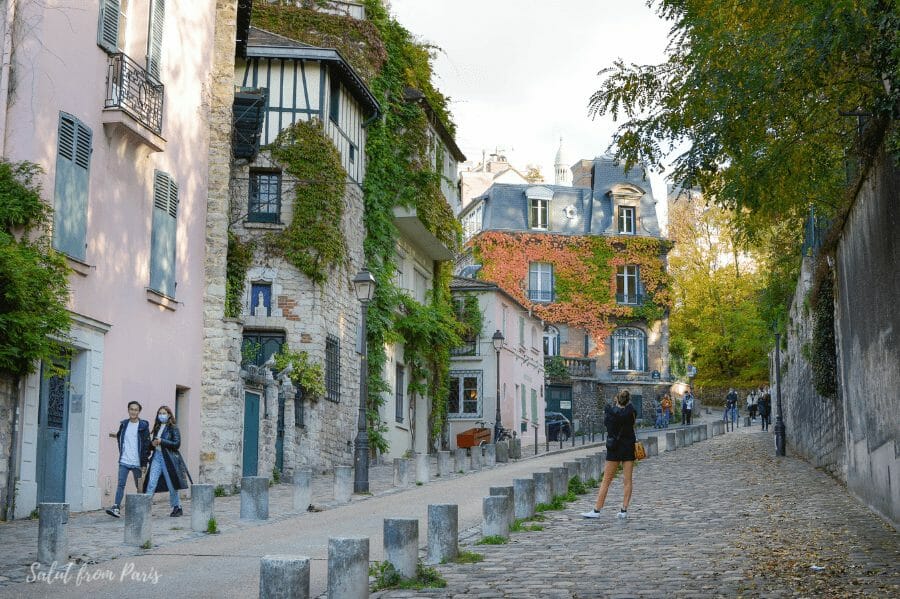
Rue de l’Abreuvoir is often called the most beautiful street in Paris. I haven’t walked every single street in the city — but I understand why it gets that title.
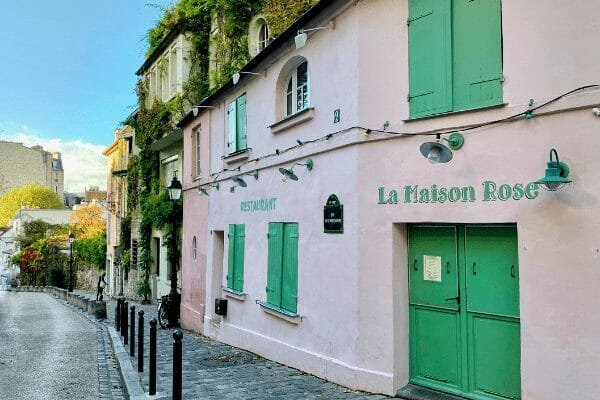
The gentle curve, the cobblestones, the ivy-covered façades. At the top sits La Maison Rose. At the lower end, the Dalida bust. In between? That perfectly framed Montmartre moment everyone hopes to find.
If you want one photo for your social media channel that captures the village charm of this neighborhood, this is it.
Just come early. Later in the day, you won’t be alone here.

#6 Get your Portrait Done at Place Du Tertre
Place du Tertre sits just a few steps from the Sacré-Cœur and is one of the liveliest squares on the hill. Framed by cafés and small restaurants, it’s easy to find — and hard to miss once you’re there.
In the middle of the square, artists set up their easels and display their work. You can commission a quick portrait or caricature for a unique souvenir from Paris, or simply pause to watch the process unfold. Even if you don’t sit for a sketch yourself, observing the painters at work is part of the experience.
It’s undeniably busy, but it captures that classic Montmartre image many visitors have in mind — art in the open air, surrounded by café tables and cobblestones.

#7 Watch the Sunset over Paris
With its elevated position, Montmartre offers some of the finest sunset views in Paris. The steps of the Sacré-Cœur are the classic vantage point, where the city gradually shifts from gold to blue as the lights come on.
If you prefer something a little calmer, head to the terrace at Relais de la Butte, tucked away near the quieter side of the hill. It’s a smaller, more relaxed setting with open views across the rooftops.
Open year-round, it’s a good alternative when the main steps feel too crowded — especially if you’d rather enjoy the view with a drink in hand and a bit more space around you.

#8 The Vineyard of Montmartre (Clos Montmartre)
Montmartre’s small vineyard, the Clos Montmartre, is one of the neighborhood’s most surprising sights. Tucked behind gates near the hilltop, it feels almost out of place — a reminder that this area was once a village surrounded by fields and windmills.
Visits are possible through guided tours organized by the Musée de Montmartre. I joined one recently and loved the experience. Walking between the rows of vines while hearing about Montmartre’s wine-growing history adds an entirely different layer to the district.
The wine itself is produced in small quantities, largely by volunteers. You won’t find it in shops, but during the annual Fête des Vendanges, bottles are sold at the museum — with proceeds supporting local charities.
Last year, I bought one for €35. It felt less like a wine purchase and more like contributing to a very Montmartre tradition.

#9 Find all 3 Windmills of Montmartre
Ever wondered why the Moulin Rouge features a windmill on its roof?
Before Montmartre became synonymous with artists and cabarets, the hill was dotted with windmills. In the 19th century, there were around 30 of them, used to grind flour and press grapes. They became a defining symbol of the elevated village that once stood outside the city limits.
You can still spot windmills in paintings at the Musée de Montmartre, where they appear as part of the rural landscape artists once knew.
Today, only two historic windmills remain:
- The Moulin de la Galette (also called Blute-Fin), built in 1622. It’s the only remaining windmill structure in Paris, though it’s privately owned and not open to visitors.
- The Moulin du Radet, dating from 1717, now incorporated into a restaurant.
And yes, the red windmill atop the Moulin Rouge makes three — though that one is decorative rather than historic.
If the name Moulin de la Galette sounds familiar, it may be because of Pierre-Auguste Renoir. His famous painting Bal du moulin de la Galette was inspired by this very spot, adding another artistic layer to Montmartre’s windmill story.
Hence, an important step if you want to visit important Impressionism art spots in Paris.

#10 Visit Église Saint Pierre de Montmartre
Right next to the Sacré-Cœur, you’ll find one of the oldest churches in Paris — and one that many visitors completely overlook.
From a distance, Église Saint-Pierre can almost be mistaken as part of the basilica complex. It sits quietly beside the grand white domes, and compared to Sacré-Cœur, it feels almost modest. But step inside.
Construction began in 1133, making it one of the oldest surviving churches in the city. The interior is simple, intimate, and full of character — old stone columns, stained glass, and a calm that contrasts beautifully with the busy square outside.
And because most people head straight to Sacré-Cœur, you often get to enjoy it in peace.

#11 Visit the Montmartre Cemetery
Paris’ cemeteries are surprisingly popular places to visit. It may sound unusual at first, but these graveyards are more like open-air sculpture parks — peaceful, historic, and full of stories.
Most visitors know the famous Père Lachaise Cemetery, but Montmartre has its own impressive burial ground: the Cimetière de Montmartre. It’s the third largest cemetery in the city and feels quieter and less overwhelming than Père Lachaise.
Among those buried here are the painter Edgar Degas, the writer Émile Zola, and the singer Dalida.
One common misconception: many assume Alexandre Dumas, author of The Three Musketeers, is buried here. In fact, his remains were transferred to the Panthéon, where France honors some of its most significant historical figures.

#12 Take the Funicularie de Montmartre
When you are in Montmartre, you have the option to ride a special train: The Funiculaire de Montmartre. Originally built in 1900, it is the only remaining funicular in Paris. The ride itself is short, but it gives a great view of the city.
The cars are small and often crowded, but it is still a fun ride. and I recommend it to anyone who wants to experience something different in Paris or who simply can’t or doesn’t want to walk all these stairs.
The Funiculaire is part of the public transportation system in Paris and requires a normal Metro ticket.
My tip: I often see street vendors selling cheaper tickets close to the ticket booth. They are usually not valid and you will get fined when using them. Better get them from the booth or use the RATP app on your phone.

Hidden Gems in Montmartre
#13 Shake Hands with the Passe Muraille
One of Montmartre’s more unexpected landmarks is Le Passe-Muraille, a life-sized bronze sculpture hidden away on Place Marcel Aymé.
The statue pays tribute to the writer Marcel Aymé and his short story Le Passe-Muraille (“The Man Who Walked Through Walls”). In the tale, the main character suddenly discovers he has the ability to pass through solid walls — a talent he uses for increasingly mischievous (and criminal) adventures.
The story takes a darkly humorous turn when his powers fail at the worst possible moment — leaving him stuck mid-wall.
The sculpture captures exactly that scene: a man frozen halfway through stone, as if caught between two worlds. It’s a small but memorable stop while wandering Montmartre’s side streets.
If you never heard of Marcel Aymé, don’t worry. I only learnt about myself him when my son had to read the book in school.

#14 Find the Buste de Dalida
Dalida was one of France’s most celebrated singers, with an international career that spanned decades. Despite her success, her personal life was marked by several tragedies, and she died in 1987.
She lived in Montmartre, and her presence is still strongly associated with the neighborhood. If you visit the Cimetière de Montmartre, you can see her grave, which remains one of the most visited there.
You’ll also come across the Buste de Dalida at the lower end of Rue de l’Abreuvoir. The bronze sculpture serves as a tribute and has quietly become one of Montmartre’s recognizable stops.

#15 Discover the Two Vintage Carousels of Montmartre
Most visitors recognize the carousel at the foot of the Sacré-Cœur — the one that appears in countless Montmartre photos, often framed with the white domes rising behind it. Officially known as the Carrousel Saint-Pierre, it adds a nostalgic foreground to one of Paris’ most famous views.
But there’s a second carousel many people miss.
Near the Abbesses Metro Station, just beside the Le Mur des Je t’aime, you’ll find another vintage-style merry-go-round. It’s smaller and usually less photographed, but it has the same old-world charm — especially lovely in the evening when the lights come on.
They’re simple stops, but they add that slightly whimsical touch Montmartre does so well.


#16 Take a picture of the Sinking House
I almost hesitate to include this one because it’s a bit of a silly illusion — but since we’re aiming for a complete guide, here it is.
Right next to the Sacré-Cœur, there’s a house that appears to be sinking into the ground. Depending on the angle of your photo — especially if you tilt your camera slightly — the building looks as if it’s sliding downhill.
Of course, it’s not actually sinking. It’s simply an optical illusion created by the steep slope and perspective. But once you see it, you can’t unsee it.
A little silly? Yes.
Still worth a photo? Maybe.

#17 Find the Hidden Lantern in Autumn
It does sound a little like the “sinking house,” doesn’t it? Another small detail that somehow became a full-blown Montmartre attraction.
If you’re visiting Paris in Autumn and notice a line of people waiting in front of a simple street lantern, congratulations — you’ve found it.
The lamp post is half covered in ivy that turns deep red and orange in fall. With the right light, it looks beautifully cinematic — the kind of moody Paris moment that does very well on Instagram.
Is it just a lantern? Yes, it is.


#18 Say I Love You at “Le Mur de Je T’aime”
Le Mur des Je t’aime — the “I love you wall” — is exactly what the name suggests: a tiled wall featuring the phrase I love you written 311 times in more than 250 languages.
It’s not one of Paris’ grand monuments, but that’s precisely its appeal. It’s simple, symbolic, and quietly romantic — a small tribute to love in a city that has built its reputation on it.
You’ll find it in Square Jehan Rictus, just steps from the Abbesses Metro Station. It’s an easy stop while exploring the area and a sweet place for a photo — whether you’re traveling as a couple or simply enjoying Montmartre on your own.


#19 Walk the Stairs at Abbesses Metro Station
I see the Abbesses Metro Station often popping up on lists of things NOT to do in Paris and for a long time, I couldn’t understand why.
Too dark? Too sketchy? Too dirty? Nope. It’s the stairs.
Abbesses is one of the deepest metro stations in Paris. Sitting about 36 meters below ground, it requires a long spiral climb before you reach daylight. It’s not dangerous , t’s just… a workout.
That said, once you make it up, you’re greeted by one of the prettiest Art Nouveau metro entrances in the city. The iconic green, wrought-iron design makes the effort feel worth it.
If stairs aren’t your thing, there’s also an elevator. Just expect a bit of a wait during busy hours.
The other station serving the hilltop is Lamarck–Caulaincourt Metro Station, which also sits deep below street level. You’ll either climb, or queue for the lift.
Consider it part of the Montmartre experience.

#20 Snap a Picture of La Maison Rose
La Maison Rose is easily one of the most photographed corners in Montmartre, and for good reason. The soft pink façade, green shutters, and ivy climbing the walls make it look like it belongs in a painting.
The house was purchased in the early 20th century by Catalan painter Ramon Pichot, who used it as both a home and studio. Artists like Pablo Picasso and Salvador Dalí were among the creative circle that gathered here.
It was Pichot’s wife, Germaine Gargallo — a well-known Montmartre figure and muse to several painters — who painted the house pink and later opened it as the restaurant we know today. (and a good one!)

#21 Look for Space Invaders
➤ Read more here: Space Invader in Paris: A Street Art Hunt
Maybe you’ve never heard of Invader — but I’m almost certain you’ve seen his work.
Those small, colorful mosaic tiles featuring pixelated little characters attached to walls, street corners, and building façades? Those are Space Invaders. And once you start noticing them, you’ll see them everywhere across Paris — especially in Montmartre.
What makes it even more fun: you can “collect” them using the Flash Invaders app. When you spot one, you scan it and earn points. It turns your stroll through Montmartre into a mini treasure hunt.
It’s simple, a little nerdy, and surprisingly addictive — a modern layer of street art woven into one of Paris’ most historic neighborhoods.

#22 Get Your Own “Old Press” Copy
When wandering around the Sacré-Coeur, watch out for Old Press, a vintage-style photographer. With their setup, they seem to come straight from another era.
They’ll snap your picture in front of the basilica and print it on a newspaper page—a one-of-a-kind Paris souvenir.
When I was in Montmartre with my friend Merryl, we took the occasion and got our picture taken. It was fun and the newspaper turned out lovely. The most surprising was that the whole process took seconds!
There’s no set price; it’s donation-based, so you pay what it’s worth to you. It’s a simple, personal way to take home a memory of Montmartre.


#23 Visit the beautiful Halle Saint-Pierre
Halle Saint-Pierre is one of those places that instantly catches your eye. The historic market hall architecture alone makes it photo-worthy: iron structure, large windows, and that slightly nostalgic Parisian feel.
Inside, you’ll find a cultural hub: a bookstore, a café, exhibition spaces, and a museum dedicated largely to outsider art and art brut. It hosts the permanent Max Fourny collection of naïve art, alongside rotating temporary exhibitions and special events throughout the year.

Art & Culture in Montmartre
#24 Watch the Street Artists of Montmartre
➤ Join my friend Kasia on one of her Art tours: more info here
Creativity isn’t contained within gallery walls up here. Beyond the exhibition spaces and portrait artists, you’ll hear musicians tuning their instruments on street corners, see illustrators sketching in real time, and occasionally stumble upon an impromptu performance.
The atmosphere feels unfiltered and spontaneous — very much in tune with Montmartre’s artistic past.
If you have a moment, take a seat on the steps below the Sacré-Cœur or around Place de Tertre and observe. Painters negotiate prices, buskers test the acoustics, visitors pause mid-climb to admire the view. It’s everyday life on the hill — layered, lively, and constantly shifting.
A practical note: you’ll likely come across roaming vendors selling cold drinks. Prices are higher than in a supermarket — you’re paying for the convenience of not having carried it uphill yourself. If you’d prefer to save a few euros, bring your own. If not, consider it part of the Montmartre micro-economy.

#25 Visit the Dalí Museum
Tucked just steps from Place du Tertre, the Dalí Paris Museum focuses entirely on the surrealist world of Salvador Dalí. Inside, you’ll find more than 300 works — sculptures, engravings, drawings, and rare prints — offering a concentrated look at his imagination beyond the famous melting clocks.
It’s smaller and quieter than Paris’ major museums, which makes it easy to explore at your own pace. If you’re interested in surrealism or want a focused art stop without the scale of the Louvre or Orsay, this is a worthwhile detour in Montmartre.
#26 Look for the Filming Locations from Amélie
If you’re a fan of one of the most enchanting films about Paris, Amélie, Montmartre offers a small cinematic detour. Several scenes from the film were shot here, and you can still visit some of the locations.
The most recognizable is Café des 2 Moulins on rue Lepic, where Amélie worked as a waitress. The interior has changed slightly over the years, but the red façade remains instantly familiar. Stop in for a coffee or crème brûlée and enjoy the nostalgia — even if it’s just for a quick look.
A short walk away, you’ll also find the former Épicerie Collignon on rue des Trois Frères, used as the neighborhood grocery store in the film. It’s a small, simple stop — but for fans, it adds a little extra magic to a Montmartre stroll.

#27 See a Show at the Lapin Agile
The Cabaret Au Lapin Agile has been a Paris institution since it first opened its doors in 1860. Originally, the cabaret was known as the “Rendez-Vous of the Thieves” and later on the “Cabarat des Assasins”(it does hint that Montmartre was a rather tougher spot, doesn’t it?).
Later, it was renamed after a sign painted by Andre Gill which depicted a nimble rabbit leaping over a fence.
Throughout the years, the cabaret has been frequented by many well-known artists and writers, including Pablo Picasso and Vincent van Gogh. Today, it remains a popular spot for tourists and locals alike, offering a glimpse into traditional French cabaret culture.
If you’re looking for an evening of entertainment with a bit of history, be sure to check out the Cabaret Au Lapin Agile.

Tours & Unique Experiences
#28 Attend the Fête de Vendanges
➤ Read more here: The Montmartre Grape Harvest Festival: Fête des Vendanges (2026)
If you’re visiting Paris in early autumn, try to catch the annual Fête des Vendanges de Montmartre.
This lively festival celebrates the grape harvest of Montmartre’s vineyard — but in practical terms, it’s a long weekend dedicated to tasting, snacking, and enjoying French regional specialties.
Expect wine stands, food stalls, music, parades, and a cheerful, slightly tipsy atmosphere across the neighborhood.
Yes, officially it honors the harvest and Parisian winemaking traditions. Unofficially? It’s an excellent excuse to eat and drink your way through Montmartre.
2026 Dates: 7 to 11 October

#29 Take a Walking Tour with a Local
If there’s one area in Paris that truly benefits from a walking tour, it’s Montmartre.
Exploring on your own is lovely — you’ll enjoy the views, the cobblestones, the atmosphere. But without context, you’re mostly seeing façades. The stories behind them remain hidden.
This hill is layered with anecdotes, rivalries, artists, scandals, revolutions, and quiet details you would never notice without someone pointing them out. A good guide connects the dots — suddenly a random house becomes Picasso’s studio, a quiet square turns into the birthplace of cabaret culture.
On your own, you’ll see Montmartre. With context, you’ll understand it.
Here are your best options:
- #1 Guided walking tour of Montmartre (typically 2-3 hours) More info here
- #2 Montmartre for Foodies: Cheese, Wine and Pastry TourGet details here
- #3 Romantic Montmartre Exploration Game – Self-guided & Budget Book here

#30 Explore Montmartre with the “Petit Train”
If you’d like an overview of the area without tackling all the hills on foot, the Little Train of Montmartre. is an easy alternative. Book your tickets here
The small tourist train connects the lower part of the neighborhood near the Moulin Rouge with the hilltop around the Sacré-Cœur. Along the way, you’ll pass key landmarks while listening to commentary about the district’s history and artistic heritage.
The route typically loops up toward Place du Tertre before heading back down again, giving you a relaxed introduction to the area.
It’s not the most immersive way to explore Montmartre because walking will always reveal more details, but if mobility is a concern or you simply prefer a gentler option, it’s a practical way to see the highlights without the climb.
You can book your tickets here in advance.

#31 Attend the Fête de la Coquille in January
Read my complete article: Fête de la Coquille in Montmartre (Food Festival)
The Fête de la Coquille Saint-Jacques is a lively two-day celebration of Brittany’s culinary traditions, usually held in January at the Place des Abbesses.
Expect generous portions of scallops (the star of the show), buttery Kouign-Amann, Galette Saucisse, Breton cider, and plenty of regional specialties. There’s also traditional music, small parades, and a cheerful village-like atmosphere that fits Montmartre perfectly.

Where to Eat & Drink in Montmartre
#32 Have Lunch in Bouillon Pigalle
Address: 22 Bd de Clichy, 75018 Paris
Bouillon Pigalle is such a great find if you look for excellent food, service, and prices all in one.
Unlike most bouillons in Paris, you can book a table, which is a game-changer when you see the lines elsewhere.
The food? Simple, authentic, and delicious. Classic French dishes done right, and the value is unreal: under 50€ for a full meal with coffee and wine – for 2!
The staff keeps things running smoothly, even when it’s busy, and they’re genuinely friendly. If you’re craving French staples like onion soup, escargot, or boeuf bourguignon, this is the place to go.

#33 Eat at La Maison Rose
Address: 2 Rue de l’Abreuvoir, 75018 Paris
I’ll admit — I hesitated before booking a table at La Maison Rose. With a façade that famous, I half expected style over substance and a forgettable, overpriced meal.
But it turned out to be quite the opposite.
Yes, the setting is beautiful — sitting inside (or just outside) that iconic pink house is special in itself. But the service was warm and attentive, and the food genuinely impressed me.
My friend and I shared a vegan mezze to start, and for the main I chose the plat du jour: chicken with a honey and lemon sauce that was both delicate and full of flavor.
It’s not a budget eatery, but it didn’t feel unreasonable either — especially considering the location and overall experience.

#34 Comptoir Breizh
Address: 9 Rue des Abbesses, 75018 Paris
If you’re after something more casual — no reservation stress, reasonable prices — Comptoir Breizh is a reliable choice.
Just don’t confuse it with the more famous Breizh Café (which, personally, didn’t wow me).
Located on Rue des Abbesses, right by the Abbesses Metro Station, it sits slightly outside the main tourist flow and feels noticeably more local. The menu focuses on classic Breton specialties: savory buckwheat galettes and sweet crêpes, plus cider to match. (love it!)
I’ve eaten here several times over the years and have always left satisfied. It’s simple, unfussy, and consistently good — exactly what you sometimes want after a long wander through Montmartre.


#35 Eat Ice Cream at Bachir
If you are up for a sweet dessert or just a little snack, you can’t miss the ice creams from Bachir.
This Lebanese ice cream shop is known for its organic ingredients and intensely flavorful scoops. Their signature is Fleur d’Oranger ice cream rolled in crushed pistachios. It’s creamy, fragrant, slightly floral and very refreshing.
Perfect as a small afternoon treat or a post-dinner dessert while wandering through Montmartre’s evening streets.

#36 Take a Coffee at Le Consulat
Address: 18 Rue Norvins, 75018 Paris
Le Consulat is easily one of the most photographed cafés in Paris, just steps away from Place du Tertre.
With its red façade, green shutters, and tiny corner terrace, it looks exactly how people imagine a historic Parisian café.
Over the years, artists such as Claude Monet, Henri de Toulouse-Lautrec, and Vincent van Gogh were said to have frequented spots like this during Montmartre’s bohemian heyday.
Today, it’s undeniably popular, and a bit (very) touristy, but still worth a pause. Whether you stop for a coffee or simply admire the façade, it’s part of the neighborhood’s visual identity and artistic lore.

#37 La Boîte aux Lettres
Adress: 108 Rue Lepic, 75018 Paris
La Boîte aux Lettres is located on a quieter stretch of Rue Lepic, away from the busiest tourist corners. On warm evenings, the terrace is especially pleasant — relaxed, local, and far less hectic than the squares around the basilica.
I went there with my parents, and we all genuinely enjoyed our meals. The menu includes classic French bistro dishes, but you’ll also find more refined plates and a daily menu that highlights seasonal ingredients.
If you’re looking for solid French cuisine in Montmartre without crazy prices or heavy foot traffic, this is a very good option.


#38 All the cafés…
Around nearly every corner, you’ll come across a café terrace — small round tables, woven chairs, and the steady rhythm of cups and conversations. They’re ideal for a break or a bit of people-watching.
My tip: If you’re after a calmer (and more reasonably priced) stop, avoid the cafés directly around Place du Tertre. A few streets lower on the hill, the atmosphere shifts. Prices drop slightly, and the clientele becomes more local.
If coffee quality matters more to you than the postcard setting, Montmartre also has excellent specialty spots.
My favorite is The Beans Are on Fire, where the focus is on exceptional beans and expertly brewed coffee. It’s the perfect stop for coffee enthusiasts exploring the neighborhood.
Address: 61 Rue des Trois Frères, 75018 Paris

Why Should You Visit Montmartre
Montmartre feels different from much of central Paris. Set on a hill in the 18th arrondissement, it combines dense city life with a more village-like layout — narrow streets, small squares, and plenty of local cafés.
Originally a separate village outside the city limits, it was incorporated into Paris in the 19th century. Even today, it retains a distinct identity and a strong connection to its artistic past.
Many visitors associate the area with films like Amélie and artists such as Pablo Picasso and Pierre-Auguste Renoir, who once lived and worked here.
At the top of the hill stands the Sacré-Cœur. The basilica is visible from across the city, and the open space in front of it offers one of the widest views over Paris.
From there, it’s worth walking into the surrounding streets. You’ll find older residential buildings, working studios, restaurants, and quieter corners away from the main flow of visitors.
Montmartre is compact and easy to navigate. Whether you’re interested in history, art, food, or simply exploring on foot, you can cover a lot in just a few hours without rushing.

Where is Montmartre in Paris?
Montmartre is located in the 18th arrondissement, in the northern part of Paris.
On a map, it may appear slightly removed from the city center, but Paris is relatively compact. From central areas, you can usually reach Montmartre in about 20 minutes by Metro.
To give you a clearer idea of distance: walking from Montmartre to the Louvre Museum takes roughly 40 minutes. It’s a straightforward walk and shows how closely connected the neighborhoods actually are.
If you’re concerned about the arrondissement’s reputation, it’s worth looking at the specifics. Like in most large cities, safety varies by street and time of day rather than by district as a whole.
I’ve written a detailed local guide about it: Is Montmartre Safe? A Local’s Perspective


How to get to Montmartre in Paris?
Paris is compact, and getting to Montmartre is straightforward. If you’re not within walking distance, the Metro is the easiest option. It’s fast, inexpensive, and depending on the station, leaves you either at the base of the hill or closer to the top.
Within Montmartre itself, the most convenient stops are:
- Abbesses Metro Station (Line 12)
- Lamarck–Caulaincourt Metro Station (Line 12)
Other nearby stations that are within walking distance include:
- Blanche, Pigalle and Anvers of Metro Line 2
- Place de Clichy, Line 13
- Barbès-Rochéchouart of Line 4 (I generally don’t recommend exiting here if it’s your first visit, it’s a bit sketchy)
Best Time to Visit Montmartre
I’m clearly not the only one drawn to Montmartre. As one of Paris’ most visited neighborhoods, the narrow lanes leading up the hill can get busy — especially in the afternoon.
And it’s not just a summer thing. The appeal doesn’t fade with the seasons. Spring light, autumn colors in the vineyard, crisp winter mornings — Montmartre attracts visitors year-round. The atmosphere changes slightly, but the crowds are never far behind.
Be it in spring and summer with outdoor picnics in front of the Sacré Coeur and nighttime Apéros.
Or in autumn, with its wonderful fall foliage that is especially nice in the little Montmartre vineyard. And in winter, when the Christmas market is installed around Abbesses.
How to Beat the Crowds in Montmartre
Montmartre draws crowds — especially on sunny weekend afternoons. The same cobblestone lanes that feel peaceful on a Tuesday morning can turn into slow-moving streams of visitors just a few days later.
If you can, aim for weekdays rather than weekends, and mornings rather than afternoons. The difference is noticeable.
And yes, I know many trips naturally fall over a weekend. In that case, timing matters even more. Arrive early, before the tour groups settle in and the terraces fill up. The neighborhood feels entirely different when you’re one of the first wandering its streets.

Or flip it entirely: go late.
Montmartre isn’t a sketchy area, and if you’re staying nearby — or don’t mind a short Metro ride back — an evening stroll can be surprisingly special. After the day crowds fade, the hill quiets down. The streets soften, the views sparkle, and the whole neighborhood feels more local again.
Around midnight, Montmartre has a completely different energy — calmer, atmospheric, and honestly a little magical.
➤ Also read my article on Safety Tips for Montmartre.
One of my favorite bars is just north of Montmartre, and I often take a detour through the neighborhood on my way home.
Map of Montmartre: The Top Sights
Knowing what to see is one thing — actually finding everything while walking around Montmartre is another.
To make it easier, I’ve pinned all the places mentioned in this guide on the map below. That way, you can navigate the neighborhood without constantly switching between apps.
To save the map, click the small square icon in the upper right corner and add it to your own Google Maps. You can also use the share function to send it to your email and access it later during your trip.
Wrap Up: Why Montmartre Deserves a Spot on Your Paris Itinerary
Montmartre offers a combination of well-known landmarks and quieter side streets within a relatively small area. You can visit the Sacré-Cœur for panoramic views, explore historic squares, stop at independent cafés, and still find less crowded corners a few minutes away from the main paths.
It’s one of the few neighborhoods in Paris where you can easily combine viewpoints, history, food, and local atmosphere in a single afternoon.
Whether you’re interested in art, architecture, or simply walking through a distinctive part of the city, Montmartre is worth including in your itinerary.

Parisienne since 2006
Expert in: Parisian Life &
French Culture, Travel
Planning, Crochet & Food and Drinks
Join me on Facebook for updates and news about Paris.
NEW: The Salut from Paris Travel Guide:
Must-Haves for Paris:
- eSim card to stay online while in Paris. I used Airalo for my travels.
- You likely need a travel adapter to plug your devices.
- Travel Insurance – if you don’t have one, VisitorsCoverage is a good option.
- If your flight is delayed or even canceled, use AirHelp to get compensation.
Tours & Attractions:
- I book tours & activities through Get Your Guide or Viator.
- Museum & Landmark tickets can be cheaper on the official page, but they are often sold out.
- I love the GoCity Travel Passes for easy planning
Flights & Transportation:
Accomodation:
- Hotels in Europe I mostly book through Booking.com (check reviews carefully)
- Vacation Rentals through Airbnb or VRBO
FAQ: Things to do in Montmartre
What is Montmartre best known for?
Montmartre is best known for the Sacré-Cœur, its artistic history, and its village-like atmosphere. The neighborhood was once home to artists such as Pablo Picasso and Pierre-Auguste Renoir, and it remains associated with creative culture and panoramic city views.
Can you see the Eiffel Tower from Montmartre?
Yes. From the steps and terrace area in front of Sacré-Cœur, you get a wide panoramic view over Paris — including a clear view of the Eiffel Tower.
Is Montmartre very touristy
Yes, especially around Sacré-Cœur and Place du Tertre. Weekends and afternoons tend to be the busiest. Visiting early in the morning or later in the evening makes a noticeable difference.
How much time do I need in Montmartre?
Plan at least 2–3 hours to walk around, see the main sights, and enjoy the views. If you add a museum visit, a meal, or a guided tour, 4–5 hours is more realistic.
Is Montmartre safe?
Montmartre is generally safe, particularly around the main sightseeing areas. As in any large city, stay aware of your surroundings and watch out for pickpocketing in crowded spots.
What’s the best way to get to Montmartre?
The easiest way is by Metro. Abbesses Metro Station and Lamarck–Caulaincourt Metro Station (Line 12) place you directly in the neighborhood. Other nearby stations are also within walking distance.
Is Montmartre worth visiting on a short trip to Paris?
Yes. Because it’s compact and walkable, you can see the highlights in just a few hours. It’s a good addition even to a short Paris itinerary.
PS: Check out these posts, they will help you plan your trip to Paris
Is your trip still a bit ahead? Pin this post now – find it back when you need it!

